
The Universal Philatelic Color Guide - UPCG
A colour reference for the philatelic community
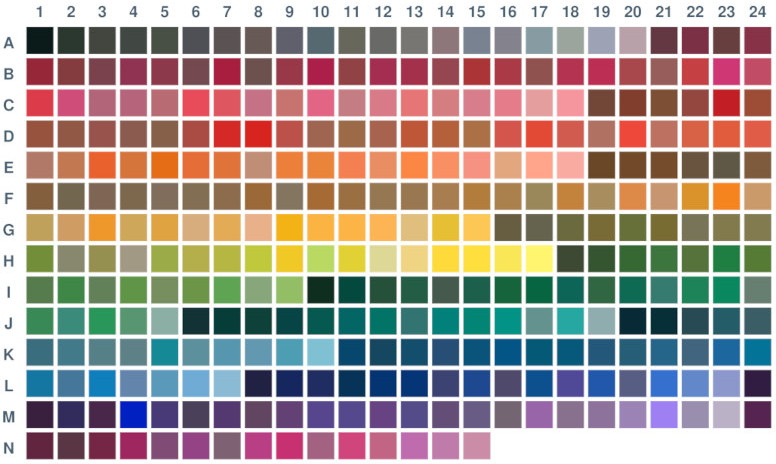
The challenge of identifying stamp colours
Colour matters to philatelists. Stamps may have been issued in several shades, some far scarcer than others and consequently commanding a substantial premium. Reliably identifying these different colours and shades is therefore an important part of stamp collecting.
Historically, collectors have used colour guides and colour keys to identify and distinguish stamp colours. Many catalogue publishers produced their own guides, which provided colour samples for comparison with the stamps listed in their catalogues.
Unfortunately, these guides have several shortcomings. Many are no longer published, so surviving copies sell at exorbitant prices. But even when available, they are not always easy to use.
One fundamental problem is the lack of a common standard. Catalogue publishers have generally developed their own colour guides, with editors or small committees choosing colour names. As a result, the same colour name can refer to noticeably different shades across catalogues. Puce, for example, as defined by Stanley Gibbons, may look quite different from puce as defined by Scott, Michel or a specialist catalogue. Nor is consistency necessarily guaranteed within a single publisher's catalogue. For instance, a colour such as Steel Blue may not represent precisely the same shade when used to describe different stamp issues within the same catalogue.
Visual comparison presents another difficulty. Colour samples in a guide are generally printed as solid blocks, whereas the same ink colour on a stamp may appear as fine lines, dots or other patterns against a contrasting background. These differences can affect how the human eye perceives the colour, making reliable comparison difficult.
A different approach to colour identification
The Universal Philatelic Colour Guide (UPCG) offers a different approach. Rather than relying on visual comparison alone, it uses digital colour analysis to help identify the closest match.
The UPCG consists of a single card containing approximately 327 colour samples. It is designed to be scanned and used with ChromaMate, free colour-matching software available for Windows, macOS and Linux.
The principle is straightforward. Instead of comparing stamp colours directly with those on a printed card, the collector scans the UPCG to create a digital reference library. ChromaMate can then compare colours sampled from scanned stamps with those in the library.
How it works
- Scan the UPCG: Use your scanner to scan the card with the settings you plan to use for scanning stamps. For the most consistent results, keep the scanner settings and image-processing workflow unchanged, avoiding automatic image adjustments where possible.
- Create a reference library: Open the scanned UPCG image in ChromaMate. The software uses the image to generate a reference colour library.
- Scan your stamps: Scan the stamps using the same scanner and settings used for scanning the UPCG.
- Find the closest match: Open the stamp image in ChromaMate and compare the colour of interest against the UPCG reference library for the software to identify the closest available colour match.
Use your own scanner
Scanners do not all reproduce colour in the same way. Differences in illumination, sensor response and image processing mean that the same stamp can produce different digital colour values when scanned on different devices.
The UPCG approach accounts for this by letting each collector create a reference library from a scan made with their own scanner under their own scanning conditions, rather than relying on colour values from another source.
REWRITE (disparate collectors can determine stamp colours consistently by using a common standard based on the UPCG):
This approach is intended primarily for relative colour comparison, rather than absolute colour measurement. For meaningful results, scan the UPCG and the stamps with the same scanner and consistent settings, avoiding automatic image adjustments where possible.
Finding the closest colour
An 8-bit-per-channel RGB image can represent approximately 16.7 million possible colour combinations. By comparison, the UPCG contains only a few hundred reference colours.
Therefore, an exact match is not always possible, nor is an exact match necessarily required.
REWRITE (Instead, the aim is to ):
The aim is to identify the closest colour in the reference library, providing a consistent and repeatable starting point for comparing stamp shades.
By combining a compact physical colour guide with digital analysis, the UPCG and ChromaMate offer collectors a practical alternative to traditional visual colour guides. They let collectors compare stamp colours using a common set of reference samples, without relying solely on the vagaries of human colour perception.